
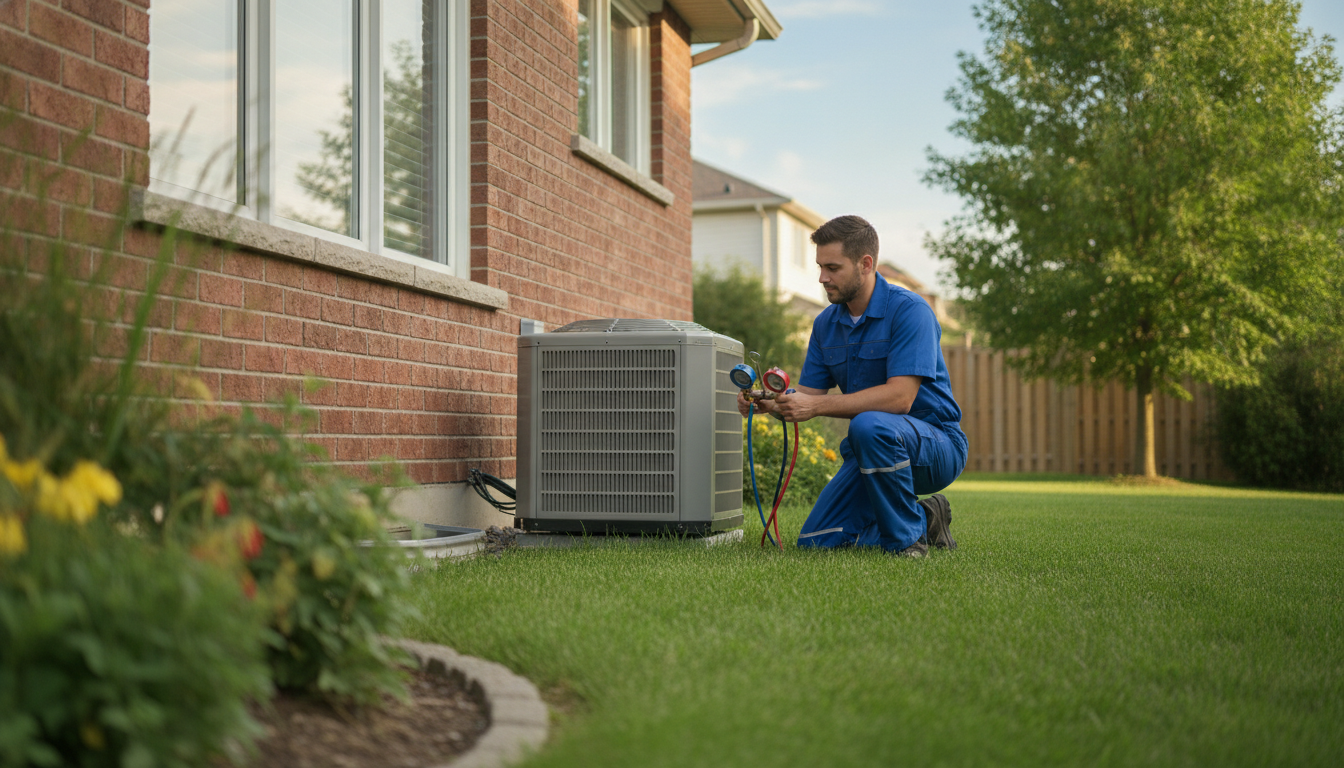
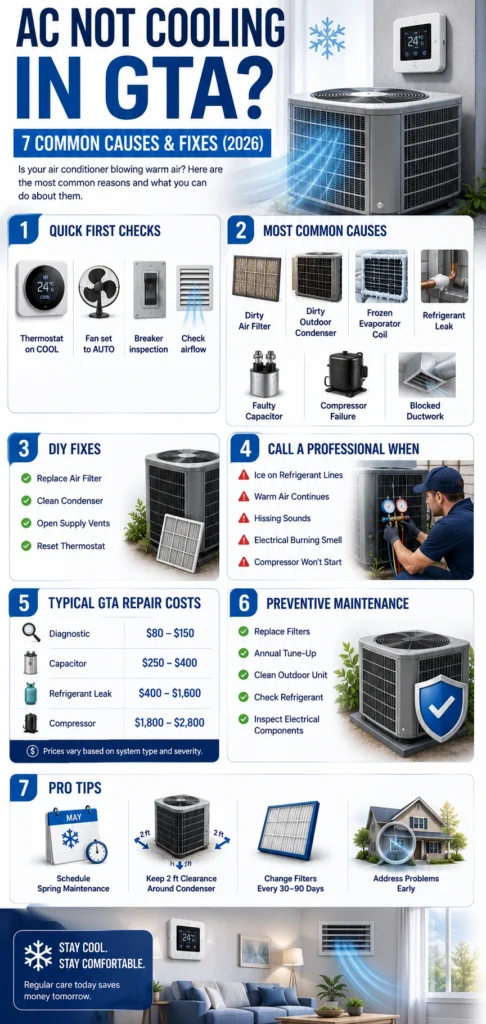
AC Not Cooling in GTA is one of the most common HVAC problems homeowners face during Ontario’s hottest summer months. If your air conditioner is running but blowing warm air, this guide explains the most common causes, safe troubleshooting steps, expected repair costs, and when it’s time to call a certified HVAC technician.
- Start with the easy stuff first. A clogged air filter or a bumped thermostat setting causes a huge share of “AC running but not cooling” calls — and both are free to fix yourself in minutes.
- A dirty outdoor condenser can’t dump heat. If the unit outside is buried in grass, leaves, or cottonwood fluff, your AC works harder and cools less — gently rinse the fins and clear a two-foot space around it.
- Ice on your AC means shut it off now. A frozen evaporator coil blows warm air, and running the compressor against it can cause permanent, expensive damage — switch to “fan only” and let it thaw.
- Low refrigerant is never a DIY job. A refrigerant leak needs a licensed technician by law in Ontario — topping it up without fixing the leak just wastes money.
- Capacitors and compressors are electrical failures. A humming outdoor unit that won’t start often points to a failed capacitor — an affordable fix when caught early, before it stresses the compressor.
- GTA repair costs vary widely. Most Ontario AC repairs land between $150 and $1,500, so knowing what’s wrong helps you avoid overpaying during peak-season demand.
- Warranty-backed work protects you. Bobby Air’s certified technicians offer 24/7 emergency service across Vaughan, Toronto, and the GTA — so you’re never stuck sweating for days.
Read on for the full breakdown of each cause, the fixes you can safely try, and the clear signs it’s time to call a pro.
Introduction
It’s 30°C in Vaughan, the humidity is brutal, and your air conditioner is humming away — but the air coming out of the vents feels like a warm breath. Sound familiar?
You’re not alone. “My AC is running but not cooling” is one of the most common calls GTA homeowners make every July and August. The good news: it’s often something small.
Before you assume the worst (and the biggest repair bill), it helps to know what’s actually going on inside your system. Some of these problems you can fix yourself in under ten minutes. Others need a certified technician — fast.
This guide walks you through the 7 most common reasons a home AC stops blowing cold air, in the order you should check them:
- The quick thermostat and filter checks that solve a surprising number of cases
- Why your outdoor unit matters just as much as the one inside
- How to spot a frozen coil or refrigerant leak before it wrecks your compressor
- What common AC repairs actually cost in the GTA in 2026
We’ll also be straight with you about when a DIY fix is safe and when it isn’t — because a wrong move on a sealed refrigerant system can turn a $300 repair into a $2,500 one.
Here’s the bottom line: a warm house doesn’t have to mean a ruined week. Most cooling problems have a clear cause and a clear fix. Let’s find yours — starting with the simplest checks and working toward the ones that need a pro.
AC Not Cooling in GTA: First Confirm It’s Really Not Cooling
AC Not Cooling in GTA is one of the most common summertime HVAC problems homeowners face across Toronto and the Greater Toronto Area. Whether your air conditioner is blowing warm air, cooling unevenly, or struggling during a heat wave, understanding the root cause can help you restore comfort quickly while avoiding unnecessary repair costs.
Is It Blowing Warm Air, or No Air?
These are two different problems:
- Air is blowing, but it’s warm or room-temperature — usually a refrigerant, coil, or airflow issue.
- Barely any air is coming out — points to a blower, filter, or frozen-coil problem.
- The outdoor unit isn’t running at all — often electrical (capacitor, breaker, or contactor).
Knowing which bucket you’re in tells you where to look first.
Check the Obvious Before Anything Else
Run through this 60-second checklist:
- Is the thermostat set to “cool” and a few degrees below room temperature?
- Did a breaker trip? Check your electrical panel for the AC and furnace circuits.
- Is the outdoor unit spinning? Walk outside and look and listen.
- When did you last change the filter? If you can’t remember, that’s a clue.
Feel the Air at a Vent
Hold your hand over a supply vent. A healthy system delivers air roughly 8–11°C cooler than the room air returning to it. If the difference is small or nonexistent, your system genuinely isn’t cooling — and it’s time to work through the causes below.
The takeaway: confirm the symptom first. Two minutes of triage points you to the right fix and helps a technician help you faster if you need one.
Cause 1: Wrong or Faulty Thermostat Settings
It sounds too simple, but a thermostat problem is behind a huge number of “not cooling” calls — and it’s the very first thing a good technician checks, too.
The Settings That Trip People Up
Walk over to your thermostat and confirm:
- Mode is set to “COOL,” not “heat” or “off.”
- The fan is on “AUTO,” not “ON.” Set to “ON,” the fan blows constantly — even when the system isn’t actively cooling — so you feel room-temperature air and assume it’s broken.
- The temperature is set below the current room temp. If the house is 26°C and the thermostat says 27°C, the AC has no reason to run.
That “fan ON” mistake alone fools homeowners every summer.
Dead Batteries and Bad Placement
Many wall thermostats run on batteries. A dying battery can cause erratic behavior or a blank screen — swap them as a first step.
Also check *where* your thermostat is. If it’s in direct sunlight or near a heat source, it misreads the temperature and short-cycles your system.
Smart Thermostat Schedules
A smart thermostat is great — until a forgotten schedule or “eco” setting quietly raises your target temperature during the day. Check the active schedule and any away/vacation modes.
The quick win: cycle your thermostat settings before assuming a mechanical failure. Set it to COOL, fan AUTO, and a few degrees cooler — then wait a few minutes to feel a change. If nothing improves, move on to the filter.
Cause 2: A Clogged Air Filter
If there’s one fix that solves more cooling problems than any other, it’s this one. A dirty air filter is the single most common cause of an AC that won’t cool — and it’s completely free to fix.
Why a Filter Chokes Your Whole System
Your AC needs a steady flow of air across its indoor coil to pull heat out of your home. When the filter clogs with dust, pet hair, and debris, airflow can drop by up to 50%.
Less airflow means:
- Weak, warm air at your vents
- A coil that can freeze into a block of ice (more on that below)
- Higher hydro bills as the system runs longer
- Extra strain that shortens your equipment’s life
How Often to Change It
For most GTA homes, a standard 1-inch filter should be replaced every 30 to 90 days. During a hot, high-use summer — or if you have pets or allergies — check it monthly.
Hold the filter up to a light. If you can’t see through it, replace it.
A Two-Minute Job
- Locate the filter slot at your furnace or air handler.
- Note the size printed on the frame (e.g., 16x25x1).
- Slide the old one out, slide a matching new one in, arrows pointing toward the furnace.
The takeaway: a fresh filter is the cheapest AC fix there is. Change it first — then give the system 15–20 minutes to recover before deciding anything’s actually wrong.
Cause 3: A Dirty or Blocked Outdoor Condenser
Homeowners obsess over the indoor unit and forget the hardest-working part of the system sits outside. Your outdoor condenser’s job is to dump your home’s heat into the outside air — and it can’t do that when it’s dirty or crowded.
What Goes Wrong Outside
The condenser is the big metal box beside your house with a fan on top. Its fins clog easily with:
- Grass clippings, leaves, and cottonwood fluff
- Dust, dirt, and pollen
- Weeds, shrubs, or fencing crowding the unit
A blocked coil means reduced efficiency, warm indoor air, and — in bad cases — compressor damage.
How to Clean It Safely
You can handle a basic cleaning yourself:
- Shut off power to the unit at the outdoor disconnect or breaker.
- Clear leaves and debris from around and inside the top grille.
- Gently rinse the fins with a garden hose from the inside out — never a pressure washer, which bends the delicate fins.
- Trim plants to keep at least 60 cm (two feet) of clear space on all sides.
Give It Room to Breathe
Airflow is everything for a condenser. Don’t stack firewood, patio furniture, or a deck box against it, and keep the top clear so the fan can exhaust heat freely.
The takeaway: a clean, unobstructed condenser is essential for cold air indoors. If you’ve rinsed it and cleared space but the air is still warm, the problem is likely deeper in the system — and worth a professional look.
Cause 4: A Frozen Evaporator Coil
Here’s a counterintuitive one: your AC can literally freeze itself in the middle of summer. When it does, you’ll feel warm air — and if you keep running it, you risk serious damage.
How to Spot a Frozen Coil
Look for these telltale signs:
- Visible ice or frost on the indoor coil or the copper refrigerant line
- Warm air blowing from the vents
- Water pooling around the indoor unit as ice melts
- Weak airflow and higher-than-normal hydro bills
Why It Freezes
A frozen coil almost always traces back to restricted airflow or low refrigerant. The usual culprits:
- A clogged filter (see Cause 2)
- A dirty coil or blocked return vents
- Low refrigerant from a leak (see Cause 5)
What to Do Right Now
Turn the cooling off immediately. This is the important part:
- Set the thermostat to OFF for cooling, then switch the fan to “ON” / “fan only.”
- Let the coil thaw fully — this takes 1 to 4 hours depending on the ice.
- Replace your filter and open all vents while it thaws.
Never run the compressor while the coil is frozen. Liquid refrigerant can return to the compressor and cause immediate, often irreparable damage — one of the most expensive failures on the whole system.
The takeaway: ice means stop. Thaw the system, fix the airflow, and if it freezes again after a clean filter and open vents, that points to a refrigerant problem — call a certified technician.
Cause 5: Low Refrigerant or a Refrigerant Leak
If your AC is clean, the filter’s fresh, and it’s *still* not cooling, low refrigerant is a prime suspect. This is where DIY stops and a licensed pro takes over.
Signs of a Refrigerant Leak
Refrigerant runs in a sealed loop — a healthy system never “uses it up.” If it’s low, you have a leak. Watch for:
- Warm air despite a correct thermostat setting
- A hissing or bubbling sound near the indoor or outdoor coil
- An oily residue around the coil or refrigerant lines
- A coil that keeps freezing even after you’ve fixed airflow
Why This Isn’t a DIY Fix
Two reasons, and both matter:
- It’s the law. In Ontario, only a certified technician can handle refrigerant — it’s an environmentally regulated substance.
- Topping up doesn’t fix anything. Adding refrigerant to a leaking system just leaks out again. A pro must find the leak, repair it, and recharge the system to the correct pressure.
What to Expect From a Technician
A proper refrigerant repair includes leak detection, the repair itself, and a measured recharge — not a quick “gas-and-go.” In the GTA, refrigerant leak repairs typically run a few hundred to over a thousand dollars depending on where the leak is and the refrigerant type.
The takeaway: low refrigerant always means a leak, and a leak always means a pro. Trying to shortcut it wastes money and can damage your compressor.
Cause 6: A Failed Capacitor, Contactor, or Compressor
When the *outdoor* unit is the problem, the cause is often electrical. These parts range from a quick, affordable swap to the most serious repair on the system — so it pays to know the difference.
The Capacitor: Small Part, Big Symptom
The capacitor gives your compressor and fan motor the jolt they need to start. It’s one of the most common AC failures. Signs include:
- A humming or buzzing outdoor unit that won’t start
- The fan not spinning (or needing a push to start)
- The system short-cycling on and off
The good news: a capacitor is an affordable, fast repair when caught early — and replacing a weak one protects the pricier parts around it.
The Contactor
The contactor is the switch that sends power to the compressor. Pitted or burned contacts cause no-starts and intermittent cooling — another routine, inexpensive fix for a technician.
The Compressor: The Heart of the System
The compressor is the most expensive component in your AC. When it fails, you’ll often see:
- No cooling at all
- Loud clunking or the unit tripping the breaker
Because a compressor replacement can approach the cost of a new unit, an aging system with a dead compressor is often better replaced than repaired.
Why Early Service Saves Money
Many compressor failures start as a cheap, neglected capacitor. A minor electrical issue left running stresses the compressor until it burns out.
The takeaway: don’t ignore a humming, hard-starting outdoor unit. A certified diagnosis catches a $250 problem before it becomes a $2,500 one.
Cause 7: Blocked Vents, Leaky Ducts, or the Wrong-Sized System
Sometimes your AC is working fine — but the *cool air isn’t reaching you.* If some rooms are icy and others are stuffy, the problem is in the delivery, not the equipment.
Closed or Blocked Vents
Cool air can only help if it can move. Check that:
- Supply and return vents are open and unblocked
- Furniture, rugs, or curtains aren’t sitting over them
- Return grilles aren’t caked in dust
Closing too many vents can actually raise pressure in your ducts and hurt overall cooling.
Leaky or Disconnected Ductwork
In many GTA homes, ducts run through hot attics and basements. Leaky ducts can lose 20–30% of your cooled air before it ever reaches a room — you’re paying to cool your attic.
Signs include uneven temperatures, rooms that never get comfortable, and dust blowing from vents. Sealing and insulating ducts is a job worth a professional assessment.
An Undersized or Aging System
If your AC simply can’t keep up on the hottest days, it may be undersized for your home or worn out. An older, low-efficiency unit struggles as it ages — and during a heat advisory, that gap really shows.
Consider a Modern Upgrade
Today’s high-efficiency air conditioners and heat pumps cool more evenly and cost less to run. If you’re facing a big repair on an old system, an upgrade may be the smarter long-term move.
The takeaway: even a perfect AC can’t beat blocked vents or leaky ducts. If cooling is uneven room to room, look at delivery — and ask a technician to check your ductwork and system sizing.
What AC Repairs Cost in the GTA (2026)
Knowing the going rates helps you budget, spot a fair quote, and avoid overpaying during peak-season demand. Here’s a realistic snapshot for the Greater Toronto Area.
Typical Ranges
Most Ontario AC repairs land between $150 and $1,500, depending on the part and labour. Common examples:
- Diagnostic / service call: roughly $80–$150
- Capacitor replacement: about $250–$400
- Refrigerant leak repair + recharge: $400–$1,600
- Compressor replacement: often $1,800–$2,800 out of warranty
- Evaporator coil replacement: $1,500–$4,500 depending on warranty
Why GTA Prices Move
A few factors affect what you’ll pay:
- Labour rates in the GTA typically run $120–$160/hour.
- Emergency, evening, weekend, and heat-wave calls often carry a premium.
- Warranty coverage on parts can dramatically cut your bill — always ask.
Repair or Replace?
A useful rule of thumb: if a repair costs more than about half the price of a new system — and your unit is 10-plus years old — replacement is often the better value. Newer systems also slash your summer hydro bills.
The Bobby Air Difference
We believe in honest, transparent pricing — no surprise fees, and warranty-backed work on every job. Our “Best Price” promise means quality parts and fair rates, even during peak season.
The takeaway: know the ranges before you book. A clear, itemized quote from a certified technician is your best protection against overpaying.
When to Call a Certified Bobby Air Technician
Some fixes are safe and simple. Others need trained hands, proper tools, and — in the case of refrigerant — a licence. Here’s how to know which is which.
Try It Yourself When…
These are homeowner-friendly, no-risk checks:
- Resetting the thermostat (COOL, fan AUTO, lower temperature)
- Replacing a clogged air filter
- Rinsing the outdoor condenser and clearing space around it
- Opening blocked vents and checking your breaker
If one of these solves it — great. You just saved a service call.
Call a Pro When…
Reach out to a certified technician if you notice:
- Ice on the coil or refrigerant lines
- A hissing sound, oily residue, or a coil that keeps freezing
- A humming outdoor unit that won’t start
- No cooling at all after the basic checks
- Warm air that won’t quit on a hot day
Don’t wait on these. A small electrical or refrigerant issue gets more expensive the longer it runs.
Why Homeowners Across the GTA Call Bobby Air
When comfort can’t wait, we show up:
- 24/7 emergency service — no-cool emergencies don’t wait for business hours, and neither do we
- Certified technicians and warranty-backed repairs
- Honest, best-price quotes with no surprise fees
- Fast, clean service across Vaughan, Toronto, Oakville, Richmond Hill, Markham, and the surrounding GTA
The takeaway: when the easy fixes don’t work, call in a pro before a small problem becomes a big one. Bobby Air keeps GTA families cool, comfortable, and confident all summer long.
If you’ve worked through these troubleshooting steps and your air conditioner is still not cooling properly, it’s time for a professional inspection. Bobby Air provides certified AC diagnostics, emergency repairs, refrigerant leak detection, compressor replacement, and complete cooling system maintenance throughout Toronto and the Greater Toronto Area. Learn more on our Professional AC Repair Services in the GTA page.
Conclusion
AC Not Cooling in GTA doesn’t always mean you need an expensive repair. Many cooling problems start with something simple, such as a clogged air filter, incorrect thermostat settings, or a dirty outdoor condenser. By checking these common issues first, you may restore cooling in just a few minutes.
If your system continues blowing warm air, freezes up, or shows signs of refrigerant leaks or electrical failure, don’t delay professional service. Early diagnosis helps prevent compressor damage, lowers repair costs, and keeps your home comfortable during the hottest months of the year.
Your next step: run the quick checks in this guide today. If the air is still warm, don’t sweat through a heat wave waiting for it to fix itself.
Call Bobby Air at (437) 922-9191 for fast, warranty-backed AC repair across Vaughan, Toronto, and the GTA — 24/7, because comfort can’t wait. One call gets a certified technician to your door and your home back to comfortable.
Stay cool out there — and remember, a warm house is almost always a fixable house.
FAQs
1. Why is my AC Not Cooling in GTA during a heat wave?
High outdoor temperatures, dirty air filters, blocked condenser coils, frozen evaporator coils, or low refrigerant are the most common reasons an AC Not Cooling in GTA during peak summer conditions.
2. Can I fix an AC Not Cooling in GTA myself?
Yes. Homeowners can safely check thermostat settings, replace dirty air filters, inspect circuit breakers, and gently clean the outdoor condenser. Problems involving refrigerant, electrical components, or compressors require a licensed HVAC technician.
3. How much does it cost to repair an AC Not Cooling in GTA?
Typical repair costs in the Greater Toronto Area range from $150 to $1,500, depending on the failed component. Compressor replacements and evaporator coil repairs generally cost the most.
4. Why is my AC running but still not cooling?
An air conditioner that runs continuously without cooling may have restricted airflow, frozen coils, low refrigerant, dirty condenser coils, or a malfunctioning compressor.5. How often should I replace my AC air filter?
Most homeowners should replace filters every 30–90 days. Homes with pets, allergies, or heavy summer usage should inspect filters monthly.
Homeowners who want to understand how residential cooling systems operate can review the technical overview provided by Energy Saver from the U.S. Department of Energy, which explains air conditioner efficiency, maintenance, and best practices for reducing cooling costs.